
Table Top Bridge – Posterior Chain Activation, Shoulder Stability & Reverse Bridge Exercise Animations
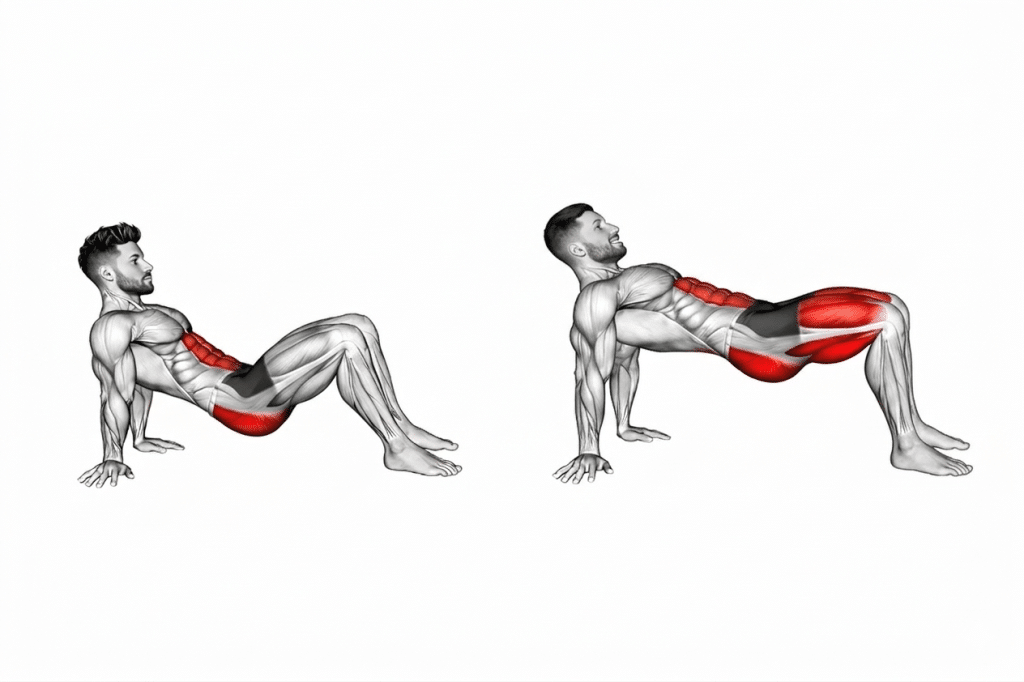
The Table Top Bridge (also called the Reverse Tabletop Bridge) is a bodyweight exercise that strengthens the glutes, hamstrings, shoulders, and core stabilizers while improving hip extension and shoulder mobility. The movement is performed by lifting the hips upward while supporting the body with both hands and feet on the floor.
Unlike traditional glute bridges performed on the back, the tabletop bridge is executed in a reverse position, requiring additional engagement from the shoulders, upper back, and arms to maintain stability.
This exercise is widely used in mobility routines, functional strength programs, yoga sequences, rehabilitation training, and posture-correction exercises. Common mistakes include dropping the hips too low, overextending the lower back, placing the hands too far from the body, or failing to keep the shoulders stable.
High-quality Table Top Bridge exercise animations clearly demonstrate proper hand placement, hip extension mechanics, shoulder alignment, and controlled tempo — making them essential for fitness apps, coaching platforms, rehabilitation software, and digital mobility-training libraries.
What Is the Table Top Bridge?
The exercise is performed by sitting on the floor with knees bent and hands placed behind the body, then lifting the hips upward until the torso and thighs form a straight horizontal line.
Professional exercise animations clearly demonstrate:
-
Hands placed behind the shoulders
-
Feet flat on the floor
-
Controlled hip lift
-
Straight line from shoulders to knees
-
Stable shoulder position
-
Smooth controlled descent
According to the National Strength and Conditioning Association, posterior chain exercises help improve overall strength, posture, and functional movement.
https://www.nsca.com/education/articles/
Why Visual Exercise Animations Matter for Reverse Bridge Movements
Reverse bridge exercises require precise body alignment. Without visual guidance, users often:
-
Place the hands too far away from the body
-
Overextend the lower back
-
Drop the hips too low
-
Lose shoulder stability
-
Rush the movement
-
Fail to maintain proper alignment
Tabletop bridge animations make correct mechanics visually clear.
Key Benefits
-
Clear hip-extension reference
-
Better shoulder-position cues
-
Improved posture awareness
-
Safer joint mechanics
-
Higher engagement in apps
-
Consistent instruction quality
Research indexed by the National Library of Medicine shows posterior chain strengthening improves stability and functional movement performance.
https://pubmed.ncbi.nlm.nih.gov/
Who This Exercise Content Is For
Table Top Bridge animations are ideal for:
-
Fitness app developers
-
Mobility training platforms
-
Yoga and pilates programs
-
Rehabilitation systems
-
Online coaching platforms
-
Functional training apps
If your platform teaches mobility training, posterior-chain strength, or bodyweight conditioning, this animation is a valuable instructional asset.
Muscles Worked
Primary Muscles
-
Gluteus maximus
Secondary Muscles
-
Hamstrings
-
Deltoids
-
Triceps
-
Core stabilizers
-
Upper back muscles
Professional animations ensure the movement remains controlled and glute-driven — not lower-back driven.
Training Applications
The Table Top Bridge is commonly used for:
-
Posterior chain strengthening
-
Hip mobility training
-
Shoulder stability development
-
Posture improvement exercises
-
Rehabilitation routines
-
Bodyweight strength programs
The American Council on Exercise recommends posterior-chain strengthening to improve posture and overall functional strength.
https://www.acefitness.org/education-and-resources/lifestyle/exercise-library/
Why Exercise Animations Outperform Traditional Videos
| Feature | Exercise Animations | Workout Videos |
|---|---|---|
| Hip-extension clarity | Excellent | Moderate |
| Shoulder positioning visibility | Excellent | Moderate |
| Looping capability | Yes | No |
| File size | Small | Large |
| App performance | Excellent | Moderate |
For bodyweight mobility exercises, animations provide clearer instruction and better integration into digital fitness platforms.
Quality Standards for Professional Table Top Bridge Animations
Commercial-grade animations must include:
-
Proper hand and foot placement
-
Controlled hip extension
-
Stable shoulder alignment
-
Neutral spine posture
-
Smooth tempo
-
Anatomically correct proportions
-
Clean distraction-free visuals
-
Seamless looping motion
-
Clear commercial usage rights
The Mayo Clinic emphasizes maintaining proper posture during strengthening exercises to reduce stress on joints and the spine.
https://www.mayoclinic.org/healthy-lifestyle/fitness/in-depth/strength-training/art-20046670
Table Top Bridge Animations from Gym-Animations.com
At Gym-Animations.com, we provide premium Table Top Bridge animations designed for professional and commercial use.
What You Get
-
Clean grayscale anatomical models
-
Accurate reverse bridge mechanics
-
Smooth repeatable loop
-
App-ready resolution
-
Full commercial licensing
-
Clear usage documentation
Explore demos
https://gym-animations.com/explore-demos/
Use Cases
These animations are widely used in:
-
Fitness apps
-
Coaching software
-
Mobility programs
-
Rehab platforms
-
Gym exercise libraries
-
Yoga and bodyweight training systems
Table Top Bridge | Reverse Bridge Exercise Animation
Plans & Licensing
https://gym-animations.com/#plans
FAQ
https://gym-animations.com/#faq
Explore demos
https://gym-animations.com/explore-demos/
Equipment library
http://gym-animations.com/gym-equipment/
Contact
https://gym-animations.com/contact-us/
Why Choose Gym-Animations.com
-
Trusted by fitness professionals worldwide
-
Built for apps and SaaS platforms
-
Scalable commercial license
-
Large mobility and bodyweight exercise library
-
Clean modern visuals
-
Clear usage rights
The Table Top Bridge is an effective exercise for strengthening the posterior chain, improving shoulder stability, and enhancing hip mobility. High-quality animations ensure correct execution across all digital platforms.